NADCA Air Duct Cleaning Standards, Explained
NADCA is the National Air Duct Cleaners Association, a nonprofit trade group for companies that inspect, clean and restore heating and cooling systems. Its main document, ACR, The NADCA Standard, sets out how a system should be assessed, cleaned and then checked for cleanliness. USA Air Management cleans ducts in New Jersey using NADCA methods.
Questions about your system? Call (908) 731-7090 or (877) 811-5131. Mon–Fri 9 am–6 pm, Sat 9 am–3 pm.
What NADCA is
NADCA started in 1989 as a not-for-profit association of companies in the HVAC cleaning business. Today it also calls itself the HVAC Inspection, Cleaning and Restoration Association, and it reports member companies in more than 30 countries. Its headquarters happen to be in Mount Laurel, New Jersey.
Besides the standard, NADCA publishes general specifications that building owners and engineers can adapt when they put a commercial duct cleaning job out to bid, plus white papers for consumers on topics such as chemical use in ducts.

What the ACR standard is
ACR stands for Assessment, Cleaning and Restoration. NADCA describes it as a performance standard, meaning it focuses on the result (a system that is verifiably clean), while also setting minimum steps a contractor should follow along the way. It applies to homes as well as commercial buildings. The current version is the 2025 edition, which NADCA offers as a free download.
In plain terms, the standard covers four things:
- Assessing the system first. Look at new or existing HVAC equipment and ductwork before deciding what needs cleaning.
- Working safely. Plan the job so it doesn't create hazards for the crew or the people in the building.
- Cleaning to a defined level. Clean and, where needed, restore components until they reach a stated level of cleanliness rather than "looks better."
- Verifying the result. Check afterwards that the components really are clean.
What's inside the 2025 edition
NADCA's summary of the 2025 edition lists procedures for:
- Choosing engineering controls and containment so dust stays where it belongs during the work
- Inspecting HVAC components
- Writing a scope of work, including a safety plan and schedule
- Using and maintaining equipment correctly, including negative-air (vacuum) requirements
- Different cleaning approaches, with source removal (physically getting the debris out) as the core, plus wet cleaning, power washing and steam where they fit
- Checking cleanliness afterwards, including two NADCA verification tests: a surface comparison test and a vacuum test
What this means for your home
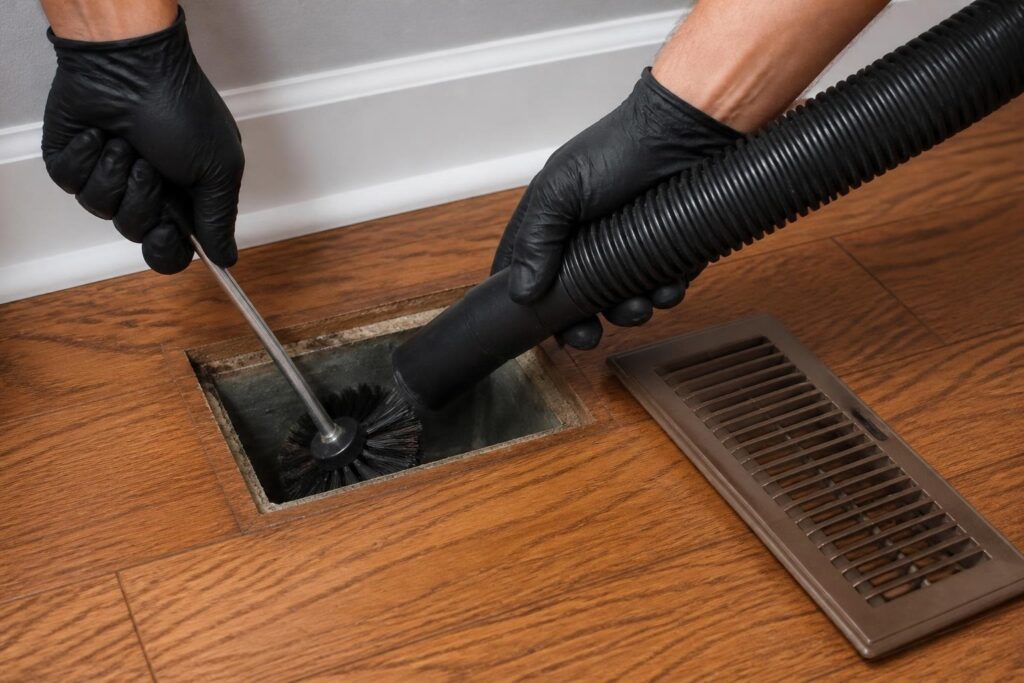
The idea that matters most for a homeowner is source removal: loosening the dust and debris and pulling it out of the system under vacuum, rather than spraying something over it. It also means cleaning the whole system, not just the vents you can see. In practice, our whole-house air duct cleaning covers supply and return vents, trunk lines, branch ducts and the furnace's main chamber, and the air handler and coil can be cleaned too (air handler and coil cleaning).
Verification is the other half. Ask to see the system after cleaning. A video duct inspection lets you see inside ducts you can't reach.
[CONFIRM: which ACR verification steps (surface comparison test, vacuum test, before/after photos) our crews actually perform, before we describe them as part of our service.]
What NADCA methods do and don't tell you
Following NADCA methods means working the way the standard describes. It is not the same as NADCA membership or a NADCA certification, which are separate programs run by the association. If a company says it is a member or has certified staff, you can ask which program it means. [CONFIRM: whether USA Air Management holds NADCA membership or any NADCA certification; until confirmed, we claim only that we use NADCA methods.]
For a government view of duct cleaning, including when it makes sense, see our guide to the EPA's duct cleaning advice.
Why homeowners choose us
- Licensed and Insured Company
- We Are Certified By Chimney Sweep and Dryer Exhaust Institute of America
- In business since 1996
- Certified technicians using NADCA methods
NADCA standard FAQs
What does NADCA stand for?
National Air Duct Cleaners Association. It's a nonprofit trade association, founded in 1989, for companies that inspect, clean and restore HVAC systems. It also uses the name HVAC Inspection, Cleaning and Restoration Association.
What is the NADCA ACR standard?
It's NADCA's industry standard for the assessment, cleaning and restoration of HVAC systems. It covers inspecting the system, working safely, cleaning to a set level of cleanliness and verifying the result afterwards. The current version is the 2025 edition.
Does the ACR standard apply to homes or only commercial buildings?
Both. NADCA writes it for residential and commercial systems. Commercial projects often name it in their specifications, and homeowners can use it as a benchmark when comparing duct cleaning companies.
How can I tell if my ducts were cleaned properly?
Look for a visibly clean system: ducts, registers, the blower and coil. The ACR standard includes verification methods such as a surface comparison test and a vacuum test. Ask your contractor to show you the work, or book a video inspection afterwards.
Is "NADCA methods" the same as being NADCA certified?
No. Using NADCA methods means following the procedures the standard describes. Membership and certification are separate programs run by NADCA, so ask a company which, if any, it holds.
Who does NADCA-method air duct cleaning near me in NJ?
USA Air Management does, from our Lincroft office in Monmouth County. We've cleaned air ducts in New Jersey since 1996 using NADCA methods. Call (908) 731-7090 or (877) 811-5131, or use our contact page.
Talk to us
Call (908) 731-7090 or (877) 811-5131, or send a message through our contact page.
Sources: National Air Duct Cleaners Association (NADCA): "Industry Standards, Specifications, and Resources"; NADCA press release on the 2025 edition of ACR, The NADCA Standard (September 24, 2025); NADCA ACR Standard download page. Read October 15, 2026.