


 By
How Often Should a Dryer Vent Be Cleaned?
Quick answer: Plan on a full dryer vent cleaning at least once a year, and clean the lint filter before or after every load. Homes with long or rooftop vent runs, large families, pets, or a dryer that takes more than one cycle to dry should be checked more often. Failure to clean is the leading cause of home dryer fires, according to the U.S. Fire Administration.
Why dryer vent cleaning matters: what the fire data says
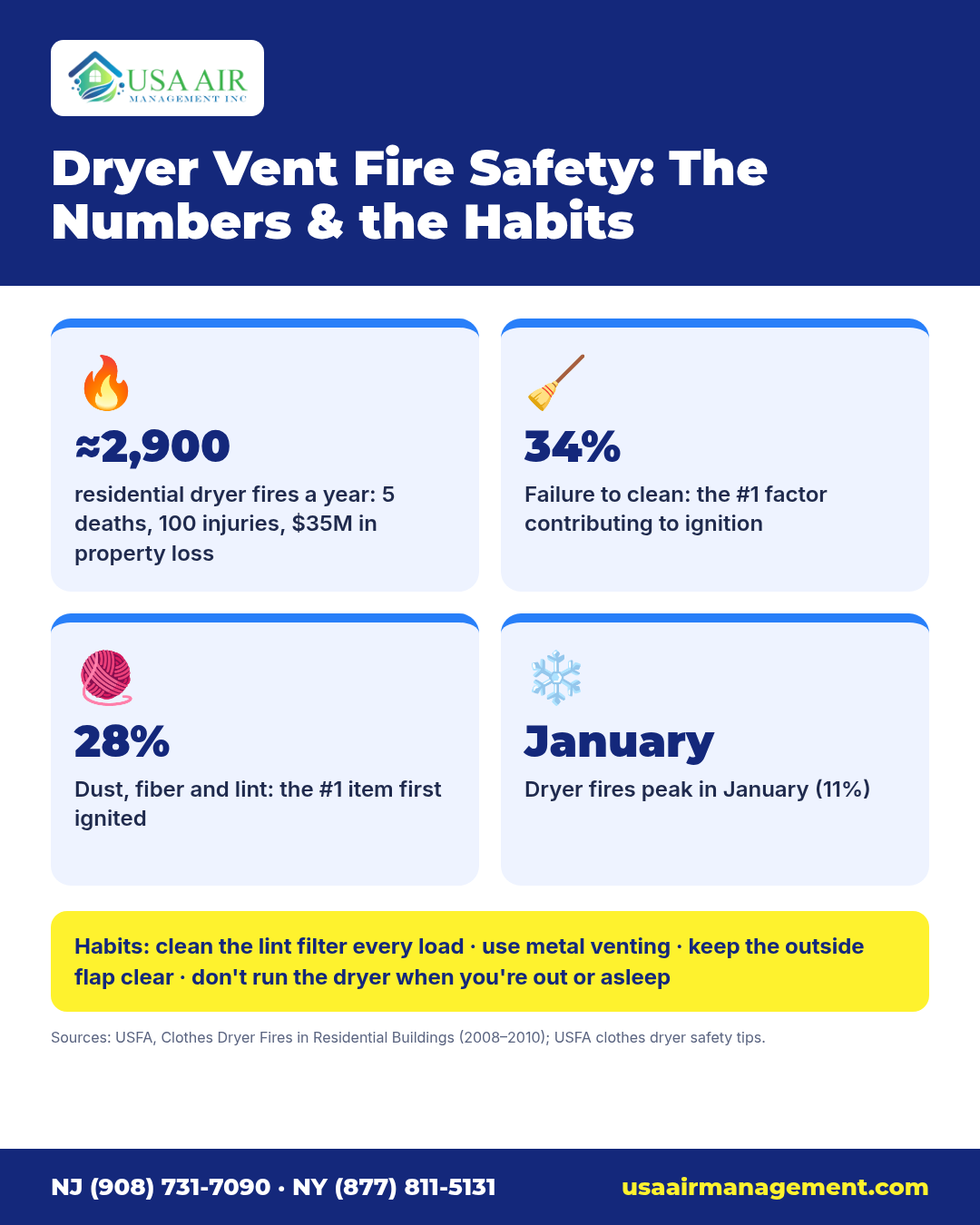
The U.S. Fire Administration (USFA) estimates that about 2,900 clothes dryer fires in residential buildings are reported to U.S. fire departments each year, causing an estimated 5 deaths, 100 injuries and $35 million in property loss. The same report found that failure to clean was the leading factor contributing to ignition, at 34%, and that dust, fiber and lint were the leading items first ignited (28%) (USFA, Clothes Dryer Fires in Residential Buildings, 2008–2010).
The lint screen catches most lint, but not all of it. The rest collects in the duct behind the dryer and at the exterior hood. As it builds up, airflow drops, the dryer runs hotter and longer, and the lint itself becomes fuel.
USFA also found that these fires were more common in fall and winter and peaked in January (11%). That is worth noting in New Jersey and New York, where heavy winter laundry and closed-up homes are the norm.
Video transcript
- Your lint screen misses lint. Your dryer's lint screen doesn't catch everything.
- ≈ 2,900 home dryer fires a year. #1 factor: failure to clean (34%). Source: U.S. Fire Administration.
- Lint filter: every load; Full vent: yearly. Clean the lint filter every load, and get the full vent cleaned at least once a year.
- Book sooner if you notice: Clothes take 2 cycles to dry, Hot laundry room, Burning smell, Outside flap doesn't open.
- We clean the whole run. Dryer to exterior, with a rotary brush and a high-pressure blower. Same flat rate on any floor, side or roof.
- USA Air Management. (877) 811-5131. usaairmanagement.com.
The baseline: once a year, plus every-load habits
For a typical single-family home, a yearly professional cleaning of the full vent run is a sensible baseline. Between visits, USFA’s dryer safety guidance recommends simple habits (USFA dryer fire report, prevention tips; USFA dryer safety flyer):
- Clean the lint filter before or after every load, and don’t run the dryer without it.
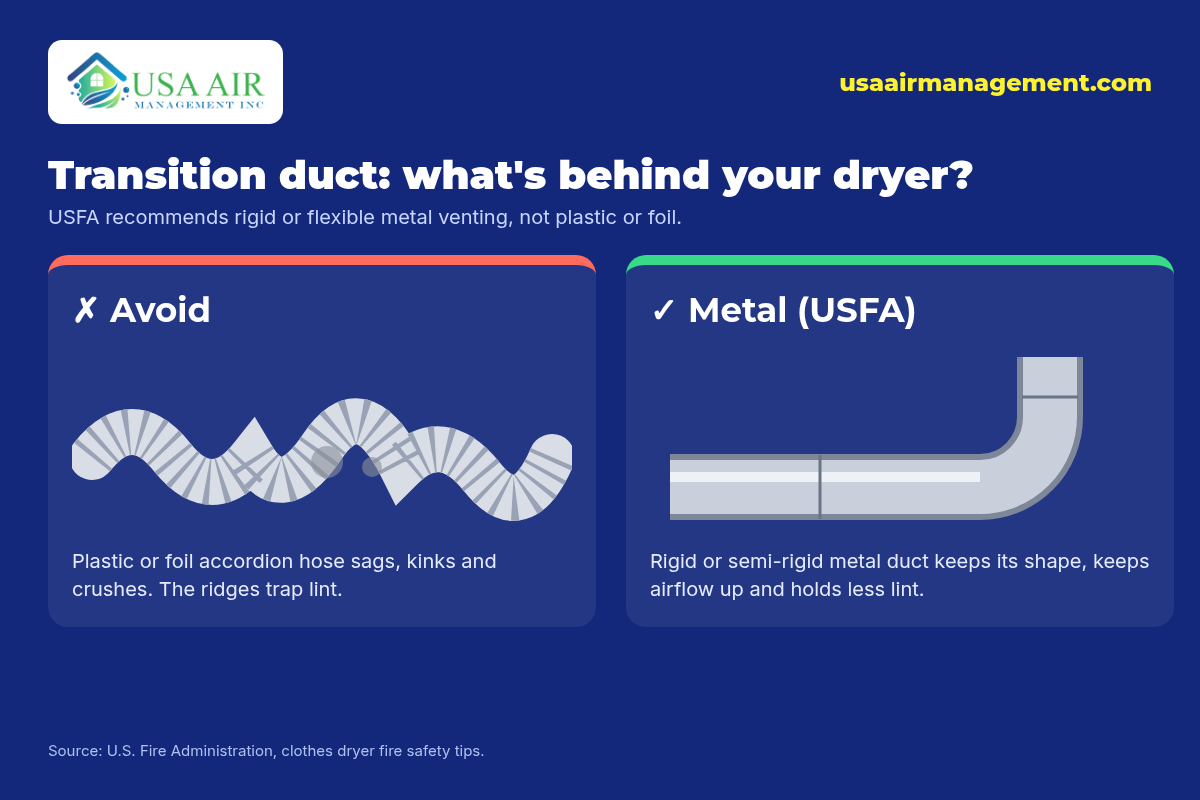
- Use rigid or flexible metal venting, not plastic or foil accordion duct.
- Make sure the outdoor vent flap opens when the dryer runs and isn’t blocked by snow, plants or nests.
- Don’t leave the dryer running when you leave home or go to bed.
When you need dryer vent cleaning more than once a year
The annual baseline assumes a fairly short, straight vent and average use. Book sooner if any of these apply:
- Long or complex runs. Dryers in a second-floor laundry, a closet, or a basement often vent through long ducts with several elbows. Each turn is another place for lint to settle.
- Roof or side-wall exits. Rooftop terminations are hard to see and easy to forget, and screens or bird guards can clog.
- Heavy use. Large households, daily towel loads, and homes with pets produce more lint.
- Townhouses and condos. Shared walls and long horizontal runs are common. Many New Jersey HOAs and condo boards ask residents for a yearly written cleaning certificate. See our HOA and condo dryer vent page.
- A recent move or remodel. If you don’t know when the vent was last cleaned, assume it’s due.
Warning signs your dryer vent is clogged
Don’t wait for the calendar if you notice:
- Clothes take more than one cycle to dry. This is the most common sign of restricted airflow.
- The dryer or laundry room gets unusually hot, or clothes are very hot to the touch.
- A burning smell when the dryer runs. Stop using it until it’s checked.
- Little or no airflow at the outside hood, or a flap that doesn’t open.
- Lint around the outside vent or behind the dryer.
- Crushed or kinked duct behind the machine.
For gas dryers, a blocked exhaust is also a carbon monoxide concern, because the combustion gases have nowhere to go. Make sure you have working CO alarms.
What a professional dryer vent cleaning should include
A lint trap and a quick vacuum behind the machine is not a vent cleaning. A full cleaning should cover the whole run, from the dryer connection to the exterior termination. At USA Air Management our technicians use a rotary brush and a high-pressure blower. Our HOA service also includes a written inspection covering airflow, exterior vent location, length and size of the duct, duct type, the number of turns and elbows, and the outside vent. Learn more on our dryer vent cleaning page and our dryer vent safety inspection page.
Our flat rate doesn’t change based on where the dryer sits (basement, garage, any floor, closet, kitchen or bath) or whether the vent exits the side, back or roof of the house. Per the coupons page, an added service charge applies in Manhattan, Brooklyn, Queens, the Bronx, Long Island and Westchester. Current offers are on our coupons page. There are neighbor and HOA group discounts, and NJ HOA pricing has county and area restrictions, so check the terms there.
One New Jersey customer put it simply: “Guy came super early was great…fair price for dryer vent cleaning” (Madelyn M., Google review).
DIY vs. professional: what you can safely do yourself
You can clean the lint screen, wash it now and then if dryer sheets leave a film, vacuum the lint housing, and clear the exterior hood. You can also replace a plastic or foil transition hose with metal. Long runs, roof exits, bird nests, and ducts hidden inside walls are better left to a professional. Pushing a brush into a long run can compact lint or pull apart joints you can’t see.
Frequently asked questions
How often should a dryer vent be cleaned?
At least once a year for most homes, and more often with long or rooftop runs, heavy use, or pets. Clean the lint filter before or after every load.
What is the most common cause of dryer fires?
USFA found failure to clean was the leading factor contributing to ignition in residential dryer fires, at 34%.
Is a foil or plastic dryer vent hose safe?
USFA recommends rigid or flexible metal venting material. Plastic and foil accordion ducts sag and crush easily, which traps lint.
Can a clogged dryer vent cause carbon monoxide problems?
With a gas dryer, yes. A blocked exhaust can push combustion gases back into the home. Keep the vent clear and install CO alarms.
How do I book dryer vent cleaning in New Jersey or New York?
Call Toll free: (877) 811-5131, or see current offers at usaairmanagement.com/coupons.
Ready to schedule? View current coupons
Sources
- USFA, Clothes Dryer Fires in Residential Buildings (2008–2010): https://www.usfa.fema.gov/downloads/pdf/statistics/v13i7.pdf
- USFA, Clothes Dryer Fire Safety flyer: https://www.usfa.fema.gov/downloads/pdf/publications/clothes_dryer_fire_safety_flyer.pdf